Setting The Homestead: How We Got 30,000 Pounds Up a Colorado Hillside
August 12, 2026
The Chassis Rule Is Changing. The Structural System Should Too.
June 14, 2026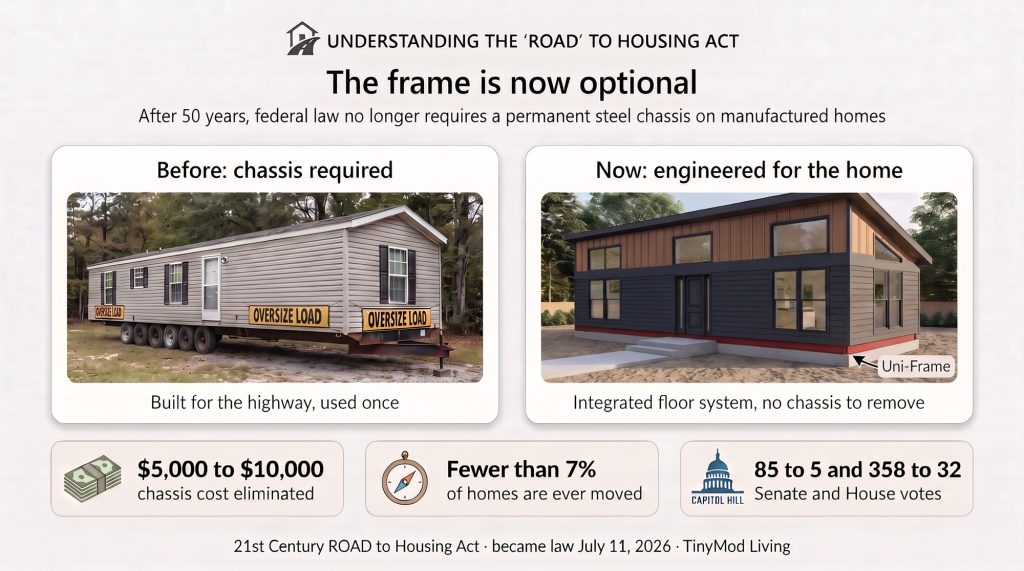
The ROAD to Housing Act Is Now Law. Here's What It Actually Means for Factory-Built Housing — and for You.
Early Saturday morning, the most significant federal housing legislation in a generation quietly became law. The 21st Century ROAD to Housing Act passed the Senate 85-5 and the House 358-32 — margins you almost never see in Washington anymore — and crossed the finish line this weekend.
You're going to see a lot of headlines about this bill. Most of them will focus on one dramatic change: after 50 years, the permanent steel chassis is no longer required for HUD Code manufactured homes.
That's a big deal. But as a factory-built home builder working with real families across Colorado and four neighboring states, we want to give you the honest, on-the-ground version of what this law does — and just as importantly, what it doesn't do overnight.
The Headline: The Frame Is Now Optional
Since 1974, federal law has required every HUD Code manufactured home to be built on a permanent steel chassis — the 10-to-12-inch steel frame that lets a home be towed down the highway. That made sense in an era when these homes were genuinely mobile. It makes a lot less sense today, when the vast majority of manufactured homes — over 90% — are never moved again after their first installation.
For five decades, homeowners have been paying for a transportation system they use exactly once. Industry estimates put the cost of that chassis at $5,000 to $10,000 per home. The new law removes the mandate. Manufacturers can still build on a chassis when it makes sense — but now engineers get to design the structure for the home, not for the highway.
Why This Matters More Than the Cost Savings
Here's where we agree with the smartest voices in our industry: the real value of this change isn't a cheaper home. It's design freedom.
Without a mandatory steel frame underneath, factory-built homes can sit lower to the ground, blend into established neighborhoods, add second stories more easily, and be engineered for the specific site and buyer instead of a one-size-fits-all federal template. Homes that look and live like site-built houses — because structurally, they can be.
There's a financing dimension too. One reason manufactured homes have historically been harder to finance is that lenders often treated them as personal property — like a vehicle — rather than real estate. That pushed buyers toward chattel loans with higher rates and shorter terms. Removing the chassis requirement opens the door for more of these homes to be classified as real property, which could unlock conventional 30-year and government-backed mortgages for more families. The law also modernizes FHA lending programs for manufactured homes and accessory dwelling units (ADUs), and raises FHA Title I loan limits.
The Part Nobody's Talking About: Modular Got a Win Too
Most of the coverage is about manufactured housing, but the law includes provisions aimed squarely at modular construction — the kind of factory-built housing we do at TinyMod™.
Quick refresher on the difference: manufactured homes are built to the federal HUD Code. Modular homes, like every TinyMod™, are built in a factory to the same state and local residential building codes as a site-built house. Our homes never needed a chassis waiver, because they were never chassis-dependent in the first place.
Section 302 — formally titled the Modular Housing Production Act — directs HUD to review its FHA construction financing programs, identify the barriers that make it harder for modular developers and their customers to access financing, and then actually fix them through rulemaking. For an industry that has struggled for years with lenders who don't quite know how to underwrite a home built in a factory, that's a meaningful step.
There's more in the fine print that matters for right-sized housing. Section 105 authorizes an FHA pilot to boost small-dollar mortgages of $100,000 or less — exactly the loan size that ADUs and compact homes need but lenders have historically ignored. Section 209 funds "pattern books": pre-reviewed home designs that localities approve in advance to streamline permitting, with a dedicated set-aside for rural areas. And Section 107 directs HUD to publish zoning guidelines recommending, among other things, the elimination of ADU restrictions and the standardization, reduction, or elimination of impact fees.
The bigger picture: Congress just put factory-built housing at the center of America's affordability strategy. Manufactured, modular, ADUs — the whole family of homes built smarter, faster, and more precisely than traditional site construction.
A Reality Check From the Front Lines
Now for the honest part. Laws change on paper faster than they change on the ground.
The federal definition changed Saturday. But the underwriting manuals, appraisal guidelines, insurance forms, permit procedures, and inspector training built around the old definition did not. Expect a transition period where lenders ask, "What exactly am I financing?", appraisers hunt for comparable sales that don't exist yet, and local building officials see chassis-optional homes for the first time.
We've seen this movie before here in Colorado. Our state passed a law requiring every residential zoning district to allow ADUs — a genuine win. But for many homeowners trying to house aging parents or adult children, projects still stall on tap fees, fire sprinkler requirements, and permitting costs that hit a small home ten times harder than a big one. "Allowed" and "feasible" are two different words.
It's telling that Congress seems to know this too — the new law's zoning guidelines specifically call out impact fee reduction as a barrier to fix. Federal guidance won't override your county's fee schedule, but it puts national weight behind the argument we've been making at hearing after hearing: fees and connection costs shouldn't price a 600-square-foot home like a 6,000-square-foot one.
The lesson: legislation opens the door. Education, clear communication, and builders who know how to navigate the details are what actually get families through it.
We Didn't Wait for the Law to Change — We've Been Building the Answer
Here's the question the entire industry is now asking: if the chassis is optional, what replaces it — in a way that engineers can certify, lenders can finance, and inspectors can approve?
Our team has been working on that answer for over a year. It's called Uni-Frame™ — a structural system developed by founders Daryl Snader and Heath Sartini, with TinyMod™ as design and sales partner. Instead of removing the chassis and leaving a structural question mark underneath, Uni-Frame™ engineers the chassis and floor as one integrated system. The system is the structure: no axles or tires to remove, no steel frame to haul back to the factory, no crane required on site — and a clear, certifiable answer when a lender or code official asks what's holding the home up.
For 50 years, factory-built homes were engineered for the highway first and the homeowner second. Uni-Frame™ flips that: engineered for the home, transportable by design. The ROAD to Housing Act just made that kind of thinking the future of the industry — and we're proud that our team was building toward it before the ink was dry.
What This Means If You're Considering a Factory-Built Home
If you're a homeowner, landowner, or family exploring a modular home or ADU in Colorado, Nebraska, Kansas, Iowa, here's our take.
The direction of travel is unmistakably good. Federal law now actively encourages factory-built innovation, financing pathways are being modernized, and the stigma gap between factory-built and site-built homes is closing fast — structurally, aesthetically, and financially.
But the details still decide whether your specific project pencils out: your county's permitting process, your utility connections, your site conditions, your financing route. That's not a reason to wait. It's a reason to work with a builder who lives in those details every day.
That's what we do at TinyMod™. We design, build, and deliver factory-built modular homes engineered to full residential code — and we walk our customers through the zoning, permitting, and financing landscape that determines what's actually possible on their land.
The law changed this weekend. The real work — turning it into real homes for real families — is exactly the work we've been doing all along.
Thinking about a modular home or ADU on your property? Start with a feasibility conversation. Contact Us and let's find out what's possible on your site.
TinyMod™ Living builds factory-built modular homes and ADUs serving Colorado, Nebraska, Kansas, Iowa, and Oklahoma. Every TinyMod™ is built to full state and local residential building code.